The Shift: From Certificate Management to Crypto-Agility
Traditionally, PKI has been treated as a static security layer - implemented once and maintained over time. However, modern environments have changed the equation.
- Machine identities now outnumber human identities.
- Certificates are issued and rotated at massive scale.
- Certificate lifetimes are shrinking dramatically.
- Cryptographic standards must evolve quickly, including preparation for post-quantum cryptography.
In this environment, manual processes break down.
Crypto-agility enables organizations to discover and manage all cryptographic assets, rapidly replace certificates and algorithms, and respond to threats without operational disruption. It turns cryptography into a flexible, adaptive capability rather than a rigid control.
Why Certificate Automation Is the Foundation
Certificate automation is the engine that powers crypto-agility.
Without automation:
- certificates expire unexpectedly, causing outages,
- visibility is fragmented, creating hidden risks,
- teams spend time firefighting instead of improving systems,
- compliance becomes reactive and difficult to maintain.
With automation:
- certificates are issued, renewed, and revoked seamlessly,
- policies are enforced consistently,
- infrastructure integrates with DevOps pipelines,
- security becomes proactive instead of reactive.
Automation doesn’t just improve PKI - it transforms it into a scalable trust platform.
The Crypto-Agility Maturity Model
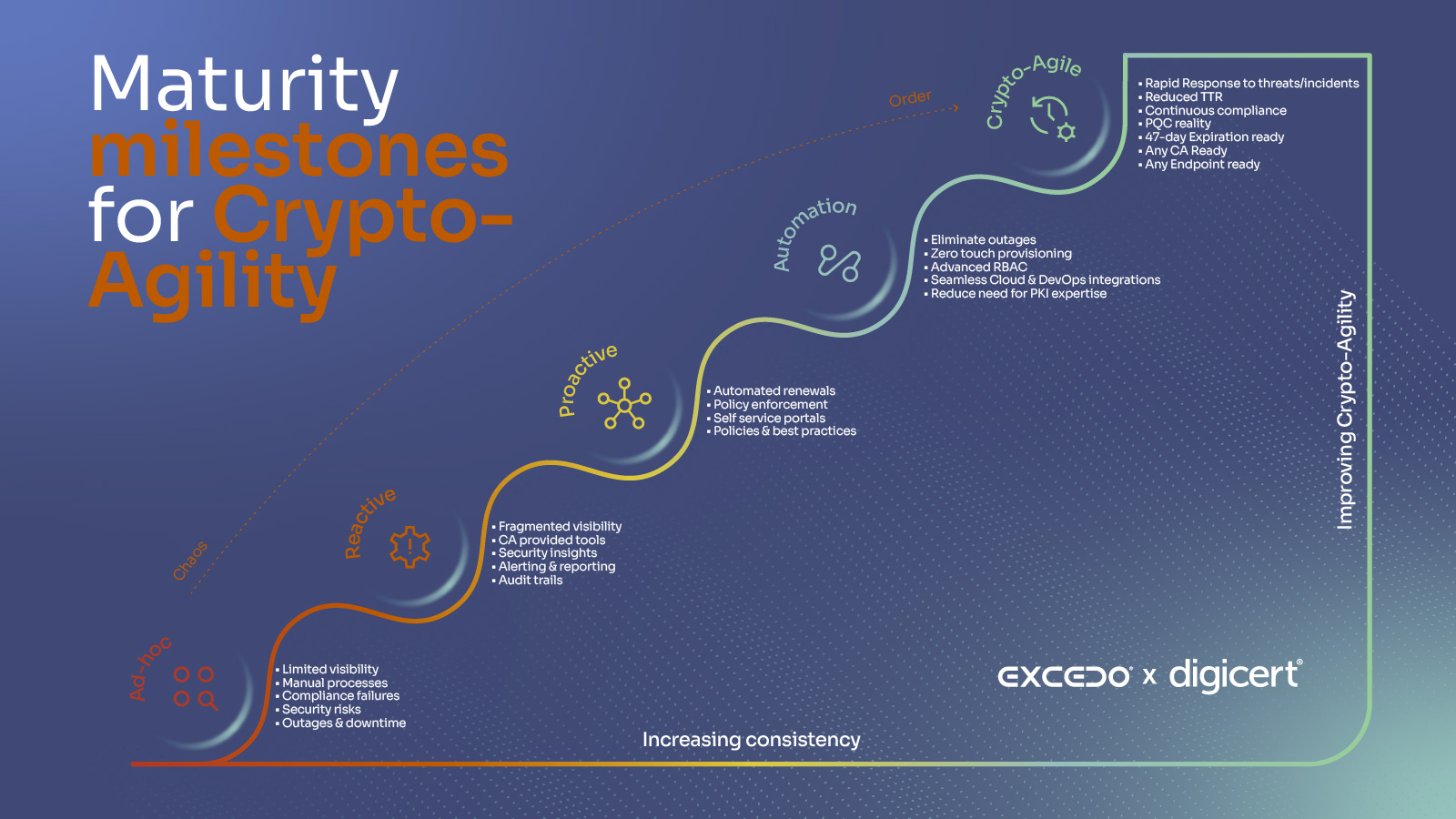
Achieving crypto-agility is a journey. Organizations evolve through five key stages of maturity.
Ad-hoc: Operating in Chaos
At the earliest stage, organizations lack centralized control over certificates.
Certificates are tracked manually, often in spreadsheets. Visibility into assets is limited. Outages occur frequently due to expired certificates. Compliance failures and audit gaps are common. Security risks are high.
This stage is unsustainable in modern environments.
Reactive: Gaining Basic Control
Organizations begin adopting tools but still operate reactively.
They introduce certificate authority tools, monitoring, alerting, and audit logging. Security insights improve, but systems remain fragmented. Teams respond to alerts rather than preventing issues.
Risk is reduced, but problems persist.
Proactive: Enforcing Policy and Standardization
The shift to proactive operations marks a turning point.
Organizations implement automated certificate renewals, enforce policies across environments, and introduce self-service portals. Best practices become standardized.
At this stage, organizations begin anticipating issues instead of reacting to them.
Automation: Scaling Secure Operations
Automation becomes deeply integrated into infrastructure and workflows.
Certificate provisioning becomes zero-touch. Certificate-related outages are eliminated. Role-based access control is implemented. Systems integrate seamlessly with cloud platforms and DevOps pipelines. Dependence on specialized PKI expertise is reduced.
PKI evolves into a platform embedded within digital operations.
Crypto-Agile: Adaptive and Future-Ready
At the highest level, organizations achieve true crypto-agility.
They can respond rapidly to threats and incidents while reducing mean time to resolution. Compliance becomes continuous. Systems support short-lived certificates, including future 47-day lifecycles. Organizations gain flexibility to work with any certificate authority across any endpoint. They are prepared for post-quantum cryptography.
At this stage, cryptographic controls can evolve at the speed of change.
Connecting the Dots: Increasing Consistency and Order
As organizations progress through these stages, consistency increases and chaos is replaced by order. Processes become standardized, visibility improves, and automation drives efficiency.
This transformation is not just technical - it reflects a broader shift in operational maturity.
The Business Impact of Crypto-Agility
Crypto-agility delivers clear business value.
- It reduces risk by eliminating expired certificates and manual errors.
- It improves operational efficiency by freeing teams from repetitive tasks.
- It accelerates innovation by aligning security with DevOps.
- It strengthens regulatory confidence through continuous compliance.
- It prepares organizations for future challenges, including quantum computing.
Building Your Crypto-Agility Roadmap
Organizations should take a structured approach to achieve crypto-agility.
- Start by discovering and inventorying all certificates to gain visibility.
- Centralize certificate management to eliminate silos.
- Implement automation early to handle issuance, renewal, and revocation.
- Integrate PKI into DevOps and cloud workflows.
- Plan for cryptographic change to ensure long-term flexibility.
Final Thoughts
Digital trust begins with PKI, but it cannot end there.
As certificate lifecycles shorten and environments become more complex, organizations must move from manual processes to automated, adaptive systems.
Crypto-agility is not just a technical upgrade. It is a strategic capability that enables resilience, scalability, and trust in a rapidly changing world.
The question is no longer whether to adopt it. The question is how fast you can get there.