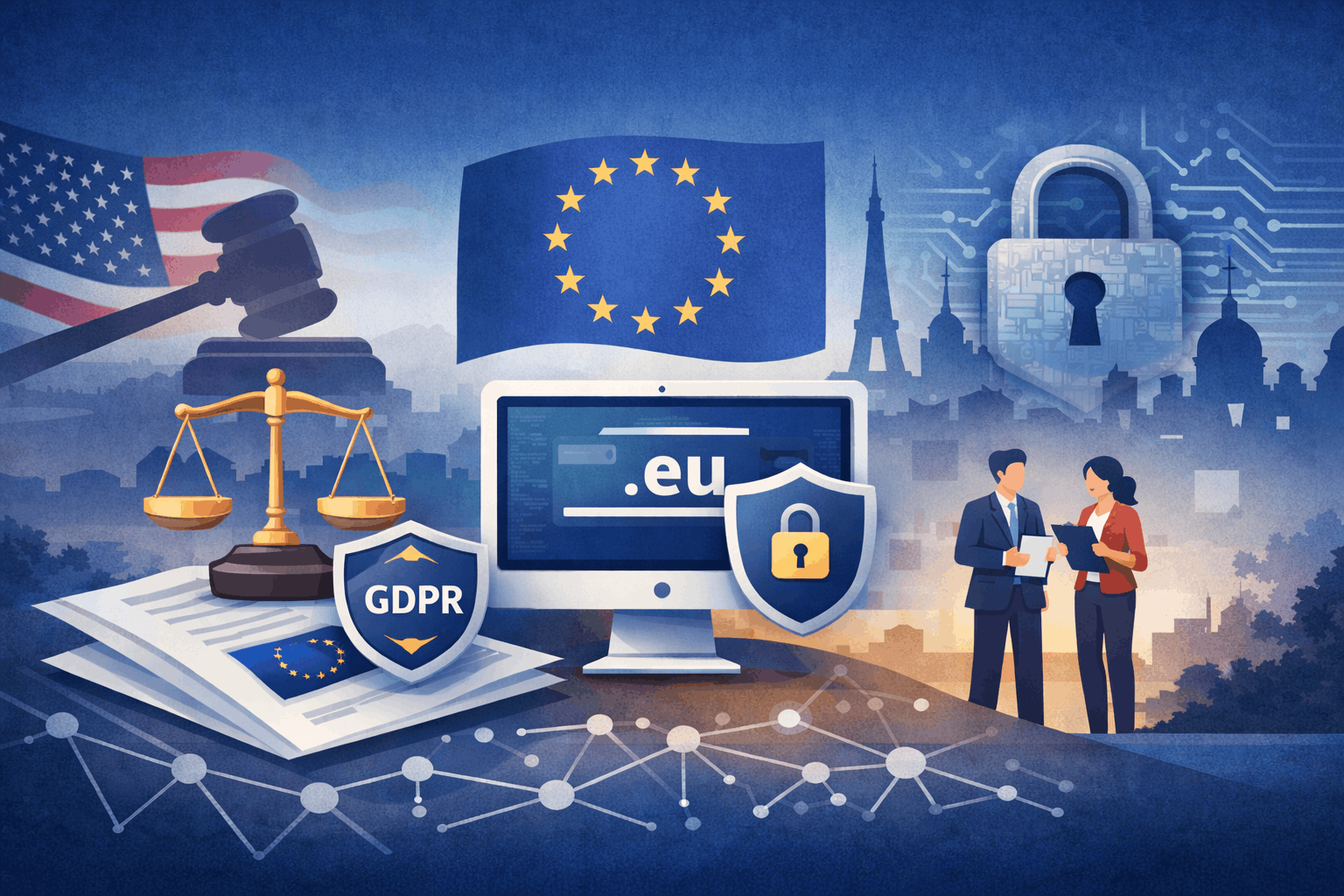
The Legal and Compliance Risks of Foreign Registrars
A domain registrar may seem like a purely technical service, but the jurisdiction it operates under can directly impact your organisation's legal exposure. When a registrar is based outside the EU, it is primarily subject to the laws of its home country - which can create serious conflicts with EU regulations and complicate compliance:
- Conflicting Jurisdictions: A foreign (e.g. US-based) registrar must obey its local laws, even when servicing EU customers. For instance, the US CLOUD Act empowers American jurisdictions to compel US-based providers to hand over customer data, even if that data resides in Europe. In concrete terms, if your domain registrar is under US jurisdiction, US agencies could demand access to account details or even seize a domain without EU approval. This extraterritorial reach directly clashes with EU data protection laws: GDPR Article 48 explicitly forbids transferring personal data to foreign jurisdictions unless approved by an EU legal framework. The EU Court of Justice’s Schrems II ruling reinforced that American surveillance laws do not meet EU privacy standards, underscoring the legal incompatibility between US demands and EU privacy rights.
- Limited EU Recourse: If a dispute or incident arises, an overseas registrar is not readily answerable to EU regulators or courts. European jurisdictions cannot easily serve legal orders or subpoenas to a provider outside their jurisdiction. In fact, some registrars openly acknowledge this limitation. For example, an US-based registrar states that it is “wholly US based” and not subject to non-US jurisdictions and therefore requires a US court order or subpoena for any customer data requests. In practice, this means an EU law enforcement agency or regulator trying to obtain information on a domain (or take down a malicious website) via Spaceship would face delays and legal hurdles, having to go through US channels. Such a gap can be disastrous in time-sensitive situations - and it also implies that EU customers’ data could be disclosed to foreign jurisdictions without any EU oversight or notification, eroding compliance with local privacy laws.
- Data Access and Privacy Risks: Using a foreign registrar can inadvertently expose personal or sensitive data to foreign jurisdiction. Under US law like FISA 702, cloud and internet service providers (including domain registrars) may be compelled to give intelligence agencies access to data. From an EU perspective, this raises red flags: European citizens and public institutions have no legal remedy in US courts if their data is collected abroad. Public sector organisations, which often handle sensitive citizen information, are particularly at risk. In Sweden, for example, government guidance (the eSam collaboration) warns that if a service provider falls under the US CLOUD Act, one must assume any confidential data handled by that provider “may be disclosed to foreign countries.” In short, a non-EU registrar introduces an inherent uncertainty - whose laws control your data and domain. This uncertainty can put an organisation on a collision course with GDPR and other regulations, even if no breach is intended.
GDPR Compliance and Legal Certainty with EU Registrars
One of the strongest reasons to choose an EU-based registrar is alignment with Europe’s rigorous data protection and cybersecurity frameworks. An EU registrar operates under EU law, offering much-needed legal certainty and straightforward compliance for European organisations:
- Stronger GDPR Adherence: An EU registrar is directly bound by the General Data Protection Regulation (GDPR), meaning it must handle customer data with the highest privacy standards. GDPR is not just about avoiding fines; it is about ensuring individuals’ personal information (such as domain registrant details) is collected, stored, and used in a lawful, transparent manner. European registrars have adapted their processes since 2018 to protect registrant data (for example, redacting personal details in public WHOIS records). By contrast, a non-EU registrar may not prioritize EU privacy requirements to the same degree, potentially putting your organisation at risk of non-compliance or data exposures. Keeping your domain registrations with a provider in the EU's jurisdiction helps ensure full GDPR compliance by design, rather than relying on a foreign provider’s voluntary or extraterritorial compliance efforts. As noted by experts, localising services within European jurisdiction inherently helps ensure GDPR compliance and limits exposure to foreign legal intrusions like the US CLOUD Act.
- Clear Legal Recourse: With an EU registrar, any disputes, data requests, or compliance questions can be handled under EU and national laws. If a government entity needs to obtain registrant information (for legitimate purposes such as investigating fraud or abuse), an EU-based registrar can comply through established EU legal channels - for example, responding to orders from an EU court or cooperating with local law enforcement under European procedures. This not only speeds up legitimate investigations but also ensures that proper privacy safeguards and proportionality assessments (required by EU law) are applied. Your organisation is not caught in the dilemma of juggling foreign subpoenas versus GDPR obligations; the legal framework is consistent. Likewise, if the registrar fails in its duties or a contractual issue arises, you have the certainty of EU-based litigation or remediation. An EU registrar means no transatlantic legal gymnastics - your domain and data are governed by the same legal environment in which you operate, providing predictability and peace of mind.
- Compliance with EU Regulations (NIS2, etc.): The EU is continually raising the bar on cybersecurity and accountability for digital service providers. The NIS2 Directive explicitly covers domain name service providers (including registrars) as “essential” or “important” entities, requiring them to implement risk management measures and report incidents. Notably, NIS2’s preamble urges organisations to evaluate the jurisdiction of their ICT suppliers as part of risk assessment. In line with Europe’s push for digital autonomy, regulators want to ensure that critical services (like government websites and public portals) are not dependent on foreign jurisdictions that might compromise security. An EU-based registrar will naturally fall under these EU regulations and oversight. It will be better prepared to meet requirements such as verifying domain customer identities (a Know-Your-Customer mandate under Article 28 of NIS2) and swiftly acting on abuse reports within the EU legal framework. By choosing an EU registrar now, organisations future-proof their domain compliance - positioning themselves ahead of stricter rules on supply-chain security and avoiding the scramble of migrating domains later if foreign providers get excluded from sensitive sectors.
Data Sovereignty: Safeguarding Control Under EU Jurisdiction
Beyond meeting the letter of the law, there is a broader strategic advantage in keeping your domain registration under European oversight: data sovereignty. Data sovereignty means that information (and the infrastructure handling it) is subject to the laws and governance of the nation or region where it is collected. For EU public bodies and companies, using an EU registrar reinforces control over their piece of the internet - their domain names and the data associated with them - in line with European values and autonomy. Here is why that matters:
- Freedom from Foreign Government Access: As discussed, a foreign registrar can bring unwelcome “surprise guests” to your data party - namely, foreign jurisdictions with their own legal keys. EU-based registrars, by contrast, are not beholden to outside governments’ laws. European firms are increasingly aware that critical online assets should remain under EU governance to prevent undue influence. The EU has even proposed that the highest security certifications be reserved for providers headquartered in Europe, storing data within EU borders and guaranteeing freedom from foreign government access. This push for sovereignty is about ensuring that no non-EU law can compel actions (like handing over data or shutting down a service) without going through EU legal processes. In practical terms, keeping your registrar EU-based means your domain cannot be yanked offline by a far-off court order, nor can your account data be accessed without EU-sanctioned due process. Especially for government websites, critical infrastructure, and sensitive enterprises, this autonomy is priceless.
- Control Over Data Location and Handling: Many EU registrars emphasize storing and processing data within Europe. This dovetails with the concept of data residency - where your data lives. Even if a foreign registrar offers European data centres, the company’s legal obligations might still allow data to be transmitted abroad or handed to foreign agencies. With an EU registrar, you can be more confident that your domain records, DNS transaction data, and personal information stay on European soil and under EU privacy shields. Such control reduces the risk of inadvertent violations of laws that restrict data from leaving the region (for instance, laws protecting government data from being stored in jurisdictions with lower privacy guarantees). Data sovereignty through an EU provider thus translates into knowing exactly who can touch your data, and under which laws - an important assurance for compliance officers and citizens alike.
- Alignment with European Digital Strategy: The EU's broader digital strategy heavily emphasizes trust and autonomy. Domain names are foundational to an organisation's digital identity - controlling them within the EU's legal ecosystem contributes to Europe’s digital self-determination. As AFNIC (the French .fr domain registry) observes, the path to digital sovereignty involves making deliberate infrastructure choices, such as using sovereign European clouds and having control over domains, to ensure European values and laws govern the critical layers of our digital lives. By choosing an EU registrar, public agencies and businesses demonstrate commitment to this principle, strengthening public trust that their online services are not subject to the whims of external powers.
Public Trust, Transparency, and Digital Autonomy
For public sector entities in particular, public trust is paramount. Citizens expect government websites and services to not only be secure, but also to uphold national and European standards for privacy and accountability. The choice of a domain registrar might seem invisible to users, yet it can have visible consequences in terms of service reliability and trustworthiness:
- Protecting Citizens’ Data and Rights: Imagine a scenario where a municipal government’s website data or DNS records are suddenly accessed by a foreign jurisdiction, or a community portal is taken offline due to a legal action abroad. Such events could erode citizens’ confidence in using online public services. By using an EU registrar, public institutions send a message that citizens’ data will only be handled according to EU law - no backdoors via foreign subpoenas. This commitment can be a selling point in public communications (“Your data stays in Europe”), reinforcing the transparency and integrity of e-government initiatives. In contrast, revelations that a public service relies on a provider subject to foreign surveillance (as happened with some cloud services in recent years) can provoke public concern and political scrutiny. Proactively avoiding those pitfalls by design -with choices like an EU-based registrar -is a trust-building measure.
- Accountability and Support: EU-based registrars are accountable to European consumer protection rules and regulators. If issues arise (security incidents, data breaches, or even something like a disputed domain ownership), an EU customer can rely on robust consumer rights and regulatory oversight to resolve the matter. Additionally, support and documentation will typically be aligned with EU languages and time zones, which is crucial for public sector IT teams that might need quick action (e.g., to suspend a malicious subdomain or update DNS records during an incident). The accessibility and accountability of a local or regional provider can mean faster response times and remedies. Meanwhile, a foreign registrar might leave you navigating unfamiliar legal territory or slower international help channels when urgency is critical.
- Reputation and Policy Alignment: For enterprises and government bodies alike, vendor choices increasingly reflect on their commitment to compliance and social responsibility. Regulators and procurement policies in the EU are gradually leaning toward favoring providers that meet EU sovereignty criteria - some tenders now explicitly ask where data will be stored and under which jurisdiction services operate. Choosing an EU registrar aligns with this trend and can be highlighted in audits or compliance reports as a risk-mitigating control. In sectors like finance, healthcare, or defense, demonstrating that core dependencies (like your domain registry services) are under EU jurisdiction can even be a competitive advantage or a requirement. It shows foresight in governance - that your organisation values digital autonomy and has taken steps to minimize geopolitical risks. In short, it is not just an IT decision but a strategic one that resonates with stakeholders and the public.
Conclusion: Mitigating Risk and Securing Digital Sovereignty
In today’s regulatory environment, the simple choice of where you register your domain name can have profound implications. EU public sector organisations and enterprises are operating under strict privacy laws (GDPR), new cybersecurity directives (NIS2), and increasing public scrutiny of how and where they handle data. Opting for an EU-based domain registrar is a smart, proactive step to meet these challenges. It provides the peace of mind that your domain - the very address of your digital presence - is managed in line with European legal standards and values.
By keeping your registrar under EU jurisdiction, you mitigate legal risks (no more wondering if a foreign subpoena might disrupt your services), ensure GDPR compliance and data protection by default, and uphold data sovereignty so that control over your digital assets remains in European hands. The advantages include greater legal certainty, smoother cooperation with regulators, and the ability to assure your users and stakeholders that critical components of your online operations are fully subject to EU oversight.
In contrast, sticking with a non-EU (for example, US) registrar might offer short-term convenience or cost savings, but it introduces uncertainties that can translate into real-world costs - whether it is a compliance violation, a delayed investigation, or a loss of public trust. The example of Spaceship’s “US-only” subpoena policy is a cautionary tale of how jurisdictional gaps can pose serious governance headaches.
In summary, EU registrars offer:
- GDPR Compliance and Data Privacy - rigorous adherence to EU data protection laws, keeping personal information safe.
- Data Sovereignty and Control - assurance that data and domains are governed by EU laws alone, avoiding foreign government reach.
- Legal Certainty and Easier Enforcement - alignment with EU legal processes for any disputes or law enforcement needs, reducing complexity.
- Enhanced Public Trust - confidence for users and citizens that digital services are protected under EU standards, reinforcing your organisation's credibility.
- Risk Mitigation under EU Regulations - preparedness for directives like NIS2 and future policies that prioritize local jurisdiction and security in supplier choices.
For public sector IT decision-makers and compliance officers, the writing is on the wall: jurisdiction matters. Choosing a Europe-based domain registrar is not about protectionism; it is about prudent risk management and upholding the legal and ethical commitments that European organisations stand for. In a landscape where digital autonomy is increasingly equated with strength, making your domain truly “.EU” at heart could be one of the most impactful decisions for your organisation's secure and compliant digital future.