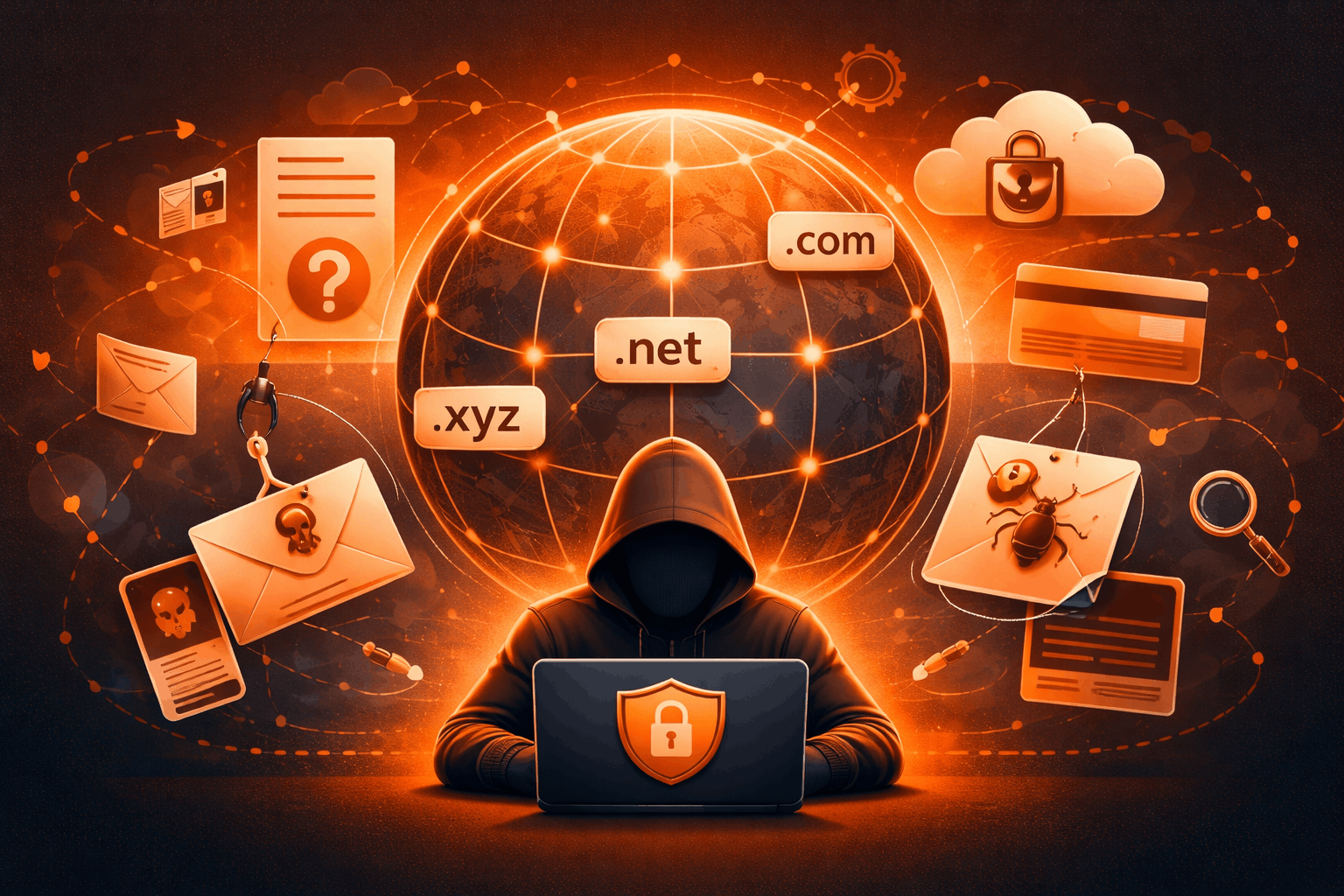
The Internet’s Biggest Abuse Enabler Is Not Malware. It is Anonymous Domain Registration.
Domain registrars do not create cybercrime - but the industry unintentionally enables a substantial portion of it.
Here is the uncomfortable reality:
The global cybercrime economy runs on cheap, fast, disposable domain registrations.
If attackers can register domains at scale with minimal identity friction, the supply of phishing sites, scam storefronts, malware landing pages, and impersonation domains will always replenish faster than defenders can block them.
This is not a tooling problem. It is a provisioning problem.
Most “Verification” Today Is not Identity Verification
Across much of the domain ecosystem, verification typically means:
- Clicking a confirmation link in an email
- Receiving a one-time code by SMS
- Passing basic format checks on contact data
That verifies reachability - not identity.
In practice, a threat actor can register domains under fabricated/false names, validate an inbox they control, and be operational within minutes. When a domain is burned, the process repeats. This is how phishing, fraud, and malware operations scale globally.
Why Domains Are So Attractive to Cybercriminals
For attackers, domains are not assets. They are consumables.
Domains are used to:
- Host phishing kits and credential harvesters
- Spin up fake login portals for cloud services
- Run scam stores and “investment” schemes
- Support malware delivery and redirect chains
- Impersonate brands, partners, and executives
The domain is the on ramp. If that on ramp is anonymous and automated, abuse becomes industrial by default.
What Would Change If Every Registrar Verified Registrants?
Now consider a different baseline:
Every domain registration requires real identity proofing - individual or corporate - reliably linked to a verified entity. Not publicly exposed. Not searchable by default. Simply verified at the source, with lawful disclosure when required.
What happens next?
1) The Cost of Abuse Increases Immediately
Cybercrime is an economy. When you raise the cost of inputs, you reshape the market.
Mandatory verification introduces friction:
- Registration is no longer instant and fully automated
- Fake or stolen identities become necessary
- Abuse becomes traceable across registrations
- Repeat offenders are easier to detect and block
Low-sophistication, high-volume attackers are hit first - and hardest.
2) Disposable Phishing at Scale Becomes Harder
The current loop - register → launch → get blocked → re-register - only works because registration is cheap and anonymous. With identity verification in place, every new domain increase attacker risk. Campaigns become linkable. Patterns emerge earlier. Scale becomes dangerous instead of safe.
3) Attackers Adapt - But at a Higher Cost
Cybercrime will not disappear. It never does.
Instead, attackers are pushed toward options that are:
- More complex (compromising legitimate sites instead of registering new ones)
- More detectable (abusing trusted platforms and redirect chains)
- Less scalable (higher effort per campaign)
- More attributable (mules and brokers leave trails)
This does not stop crime - it breaks its efficiency.
Verification Does Not Mean Public Exposure
One of the most persistent misconceptions in this debate is that identity verification equals public disclosure. It does not have to.
A workable model is straightforward:
- Verify identity at registration
- Store only what is necessary
- Protect data properly (encryption, access controls, audit logs)
- Disclose only under due process and defined authority frameworks
This preserves privacy for legitimate registrants while removing anonymity as a scaling tool for abuse.
The Bigger Risk: If Registrars Do Not Lead, Regulation Will
Governments are increasingly viewing anonymous domain registration as a fraud and public safety issue. When systemic abuse persists, regulation rarely arrives gently.
That leaves the industry with two (2) paths:
Path 1: Industry-led standards
Clear assurance levels, privacy-safe verification, consistent enforcement, and workable disclosure processes.
Path 2: Externally imposed rules
Fragmented requirements, uneven enforcement, higher compliance burden, and less operational flexibility. If you are a registrar, the choice matters. Helping shape the solution now is far better than reacting later.
What Registrars Should Do - Now
This is the wake-up call:
The domain ecosystem is being used as a crime supply chain. Treating identity as optional effectively subsidizes fraud at global scale.
Practical steps registrars can take today:
- Introduce registrant assurance levels
- Build abuse prevention into onboarding
- Detect mule behaviour and bulk abuse patterns early
- Minimize and secure verification data
- Collaborate on intelligence, reporting, and takedowns
Verification should be seen as preventive security, not administrative friction.
What Security Teams Should Expect
As registration becomes harder, attackers will shift - not stop.
Expect more:
- Compromised legitimate websites
- Abuse of trusted platforms and hosted content
- Redirect infrastructure and obfuscation layers
- Account takeovers instead of net-new domains
This shift still benefits defenders. It increases attacker cost, reduces scale, and generates stronger signals for detection and response.
Bottom Line: Identity Friction Is the Missing Control
Cybercrime thrives where:
- Setup is easy
- Accountability is low
- Replacement is cheap
Anonymous domain registration checks all three (3) boxes.
Global registrant verification would not eliminate cybercrime - but it would break one of its most profitable scaling mechanisms.
And for registrars, that is the real point:
You do not just sell domains. You shape the internet’s trust layer!