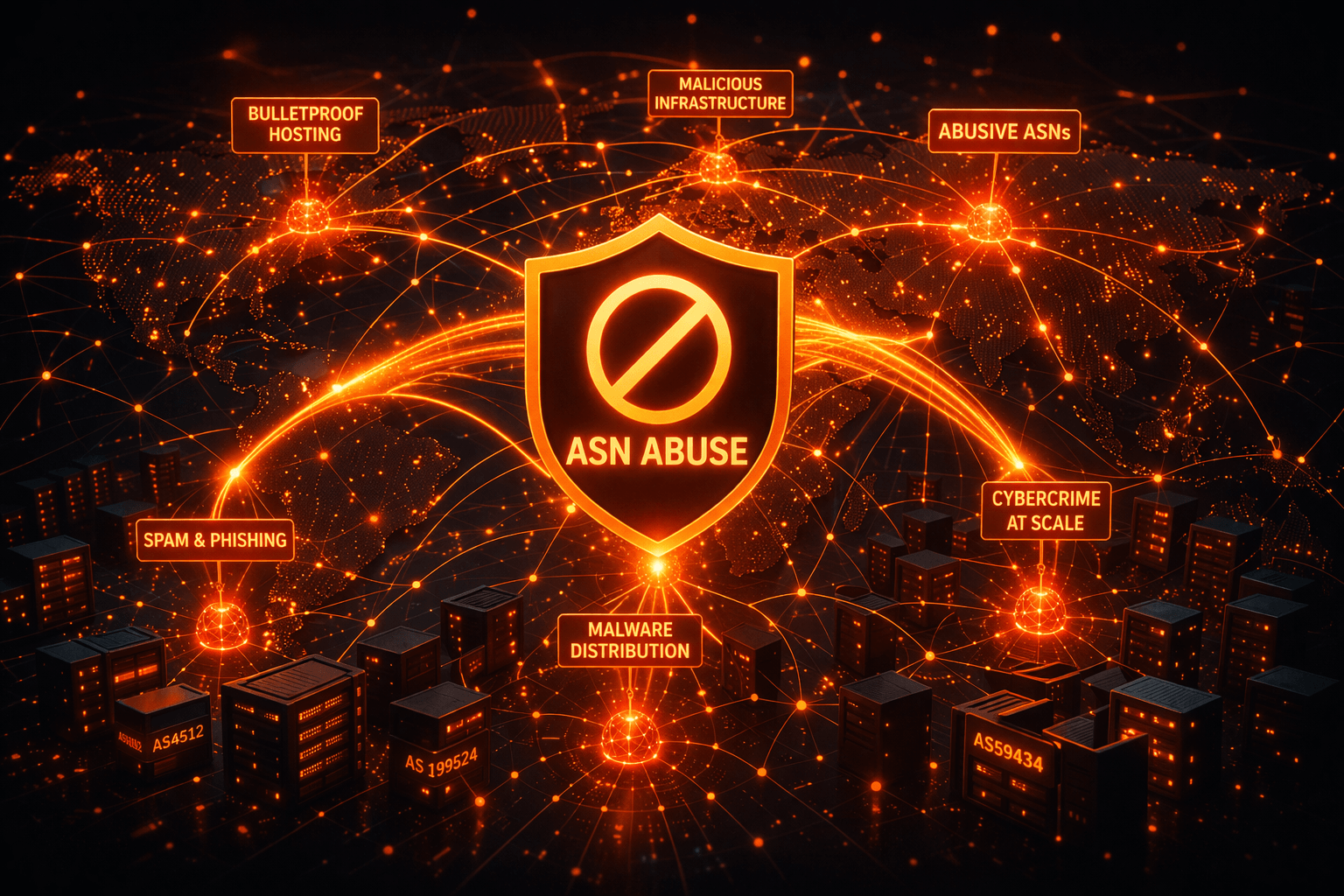
The New Entry Point: Company Formation as Infrastructure
The starting point is not a vulnerability. It is a company.
In the UK, companies can be registered quickly, cheaply, and with minimal verification. Formation agents offer fully automated services where incorporation can be completed within 24 hours.
From there, the process is straightforward:
- Register a company
- Use it to obtain ASN and IP resources
- Deploy infrastructure
- Operate or lease it
- Let the company collapse
No bypassing controls. No exploitation. Just using the system as designed.
The 12-Month Operational Window
This model works because of time.
Companies are often left non-compliant from the start:
- Filings are ignored
- Confirmation statements are missed
- Administrative warnings accumulate
Eventually, the company is struck off.
But not immediately.
The process creates an operational window of approximately 12 months - often longer.
That is more than enough time to:
- Run phishing campaigns
- Host malware infrastructure
- Operate command-and-control systems
- Lease IP space to third parties
This is not short-lived abuse.
It is structured, predictable, and sufficient to sustain full-scale cybercrime and industrialised crime-as-a-service operations..
The Reset Problem
The most important part of this model is what happens next.
Nothing.
When the company is dissolved:
- The legal entity disappears
- Accountability disappears with it
- Infrastructure can migrate or persist
- A new company is created, resetting the cycle and enabling another 12-month window for continued operations - often within days, sometimes immediately.
This is not a weakness. It is a feature - and it is being exploited at scale by cybercriminals.
Why Listing and Blocking Fail
The default industry response is still reactive:
- Block IPs
- Flag ASNs
- Share indicators
This does not work. It cannot work.
Because the infrastructure is deliberately structured to outlive detection and disruption::
- The lifecycle is long enough to generate value
- The cost of replacement is negligible
- The ability to reset is built-in
Blocking becomes a delay mechanism. Not a disruption strategy.
If you do not remove the root enabler, the problem regenerates.
Why the System Fails
This is not a failure of one organisation. It is a failure of alignment.
| Stakeholder | Responsibility | Limitation | Outcome |
|---|---|---|---|
| Companies House | Legal registration | Cannot verify identity accuracy | Cheap legitimacy layer |
| RIRs | Resource allocation | No mandate to act on abuse | ASN remains active |
| ISPs / Upstreams | Connectivity | Commercial incentives vary | Abuse tolerated |
| Threat intelligence | Detection | No enforcement power | Fragmented mitigation |
| Law enforcement | Legal action | Slow, jurisdictional | Delayed response |
Each actor operates correctly within their mandate. The system fails between them.
Identity Without Accountability
At the centre of this issue is a fundamental mismatch. Company registration is treated as a trust signal. But it is not.
Companies House explicitly states that it does not verify the accuracy of submitted information and that publication should not be interpreted as validation.
At the same time:
- Many companies have minimal transparency
- Officers are often located outside the UK
- Physical presence is unclear or non-existent
The company provides legitimacy. The operator remains invisible.
ASN Allocation: Trust Without Control
Regional Internet Registries operate under a clear mandate: allocate resources and maintain registries. They are not enforcement bodies.
This creates a critical limitation:
- ASN allocation is based on policy compliance
- Network abuse is not handled within registry processes
- Strong action often requires legal intervention
The result is simple: infrastructure used for malicious purposes can remain active because it is formally compliant according to policy.
A System That Works - For the Wrong Side
This is not a failure of individual actors.
It is a system that functions exactly as designed:
- Company registration enables access
- ASN allocation provides infrastructure
- Upstreams provide connectivity
- Detection systems provide signals
But none of these components are designed to stop the full lifecycle.
The gap is not technical. It is structural.
What Actually Works: Disruption, Not Observation
The lesson from domain abuse applies directly here.
- Visibility does not stop cybercrime
- Listing does not stop cybercrime
- Blocking does not stop cybercrime
Disruption does.
That means:
- Removing access to infrastructure
- Preventing reuse of identity
- Increasing the cost of re-entry
- Breaking the lifecycle
Anything else is containment.
What the Industry Needs to Do
This problem is solvable. But only if the response matches the model.
1. Treat identity as a security control
If companies are used to obtain critical infrastructure, their identity must be verifiable. Not declared. Not assumed. Verified.
2. Introduce lifecycle-based controls
New entities should not receive full trust immediately.
- Probation periods for ASN holders
- Gradual allocation models
- Continuous compliance checks
3. Enable enforcement at the ASN level
Policy must evolve.
There must be mechanisms to act on:
- Systematic abuse
- Repeated patterns
- Proven malicious use
Without this, enforcement does not exist.
4. Break the reset cycle
This is the most important step. As long as actors can dissolve a company, reincorporate within days, and regain access to infrastructure, the model will continue to scale.
Reset must become costly.
Conclusion
The internet has already seen this pattern. Weak identity leads to scalable abuse. The domain ecosystem proved it. Now routing infrastructure is following the same path.
If access is easy, identity is weak, and reset is free, abuse will industrialise.
The world and the internet industry need to stop treating this as a niche abuse problem and start treating it as a structural failure in how trust is granted.
That means raising the cost of entry, making legal identity meaningful, introducing friction for newly created entities, and giving the ecosystem real tools to disrupt malicious ASN use before it becomes entrenched.
The solution is not better observation. It is better disruption.
Until identity, lifecycle, and enforcement are addressed together, this model will continue to reward the actors most willing to exploit the system.
If that does not change, ASN abuse will not slow down. It will continue to scale - predictably, efficiently, and globally.